
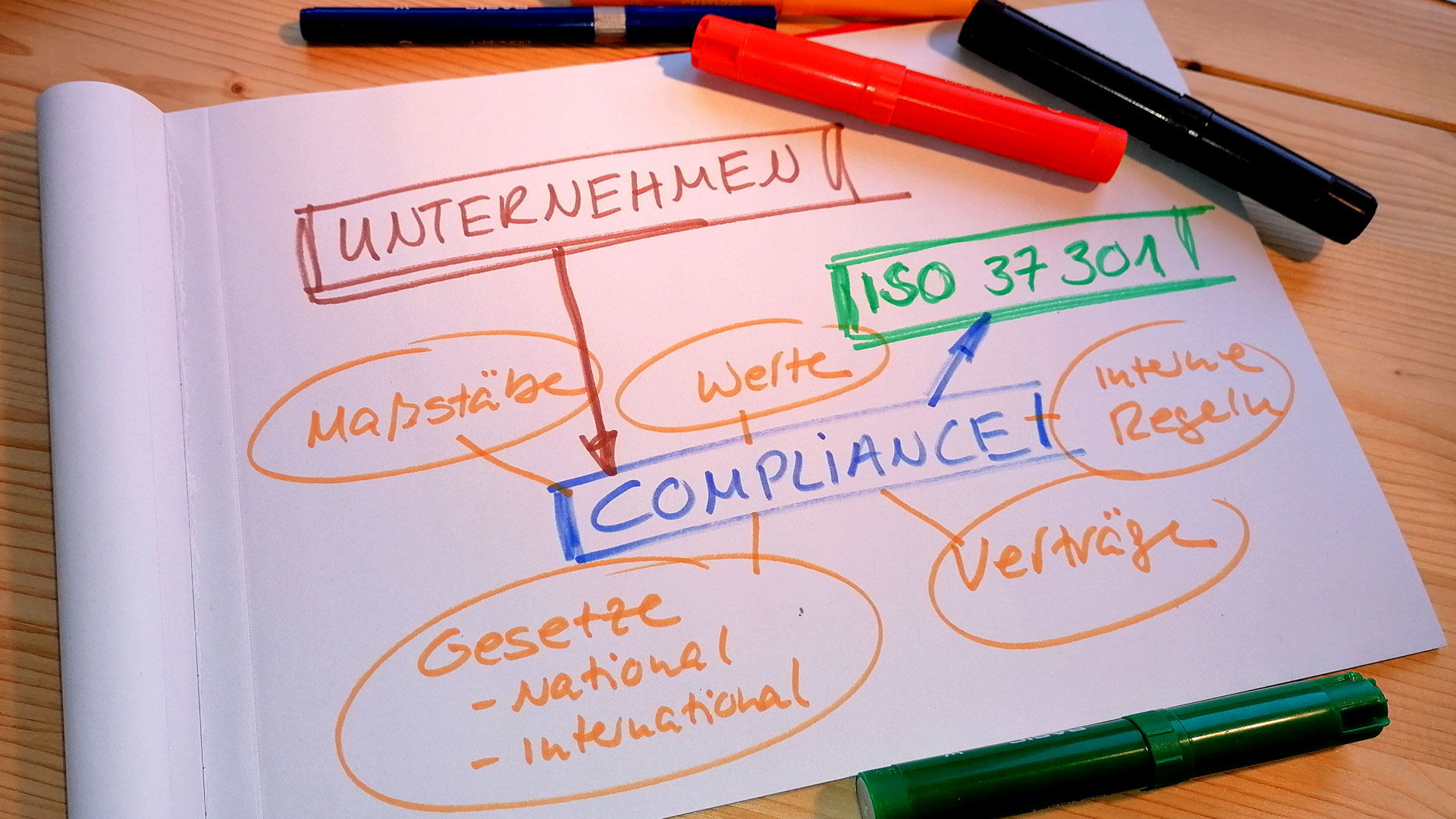
The ability to comply with regulations and requirements should be measured. Even if it seems strange to put action into a norm in accordance with values and laws, the need for binding representation of this ability increases. For companies, the visibility of this capability is very important. The modern name for compliance or compliance with regulations and requirements is "Compliance". With a Compliance Management Systems (CMS) In the meantime, companies can practically implement compliance. To do this, the compliance standard is required.
International Standards Organization (ISO) is the International Organization for Standardization. In order to be able to prove the implementation of a valid compliance management system, this organization is finally used.
Compliance standard
With ISO 37301 "Compliance Management Systems – Requirements with Application Guidance", companies can finally start up. For this reason, ISO 37301 was created to make the efficiency of a compliance management system (CMS) measurable.
This standard is therefore intended to enable companies to provide proof that they practise compliance. How good or bad the CMS works should also be measurable and visible.
Contents
The standard describes above all how a company CMS In addition, the Commission will be able to introduce, implement and demonstrate its effectiveness. Companies can then measure the ability to comply with regulations and regulations. ISO 37301 lays down the requirements for the design, implementation and processes for the concept as well as effectiveness control of a CMS.
The Mother of the Compliance Standard
The predecessor of the ISO 37301 standard is ISO 19600, which was established in 2014. ISO 37301 is therefore a further development of its predecessor and saw the light of day in design form in 2020. The new standard replaces the old one as soon as the International Organization for Standardization publishes the final version of the new standard.
Update required
The aim of the further development of the new standard was finally an update to the certifiable standard. The old ISO 19600 was never certifiable, but only thought of as a recommending standard. The new, final standard should therefore be accreditable and certified.
| Standard | Species | Status |
|---|---|---|
| ISO 19600 | Level B standard | not certifiable (only as a recommending standard) |
| ISO 37301 | Level A standard | certifiable |
Further development
However, much has not changed. So companies that have so far adapted to the old standard do not have to change much. The Level A standard was mainly formulated as a binding text. Therefore, examples were hung in an installation. Further development also includes some editorial improvements.
Companies want to provide binding evidence about their actions in accordance with values and laws. The new standard finally enables the certification of the compliance management system.
Rechtsanwalt Dipl.-Ing. Michael Horak, LL.M.
Benefits of certification
The following four points are particularly useful for companies with certification:
Counterparties
The trust between business partners should be strengthened. Large customers can better assess their partners if they can prove a corresponding CMS. The certification according to ISO 37301 reflects the CMS and serves as proof.
Calls for tenders
The ISO 37301 certification allows for a better position in tenders. In the context of major tendering procedures, certification is thus a tender criterion.
Evidence
If a company is suspected of lack of care and has to assert itself in court, certification is helpful. The certification according to ISO 37301 can therefore serve as proof of compliance with the business due diligence obligations.
Sanctions
In case of possible penalties due to compliance violations, a CMS certificate may have a negative effect on the criminal record. Sanctions may be imposed, for example, by companies in which managers commit criminal offences or violate their supervisory obligations.
ISO 37301 is a voluntary standard.
Rechtsanwalt Dipl.-Ing. Michael Horak, LL.M.
However, the publication of the final standard is still under planning.